A Pellucid perspective
State of Accounts Receivable 2026: Where cash gets stuck. How AI could change what comes next.

Late payments remain a cash-flow problem
59% of surveyed small businesses have at least some invoices 30+ days overdue. 1
$17.7K is the average unpaid invoice balance among businesses owed money. 1 Cash that has been earned but not yet received.
80% of surveyed US small businesses use AI regularly, according to the July 2026 survey. 2
39% of owners said a late payment made payroll or bills harder in the prior 12 months. 3
49% of owners reported moderate or critical cash-flow gaps from payment-processing times. 3
24/7: FedNow supports instant payments through participating financial institutions. 4
The next advance in AR is better decisions about cash
We expect AI to help teams diagnose delays, choose effective interventions and prevent repeat problems. The larger opportunity is an AR operation that learns from what actually gets paid.
Already documented: ML payment predictions and LLM account summaries. 5, 6 Our outlook concerns how these capabilities combine with agents and learning from outcomes.
Three roles in one AR operation
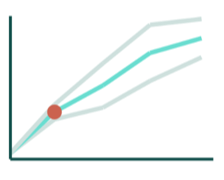 Predictive ML — Estimate timing and risk. Use payment history to estimate likelihoods and timing ranges, then check predictions against receipts.
 Language models — Interpret the situation. Read messages and documents, propose a reason for delay and link it to evidence.
 AI agents — Carry a plan through. Use models and business tools to act within permissions, check results and escalate exceptions.
ML means machine learning; LLM means large language model. LLMs are also ML models, and agents can use both. Accounting systems calculate balances; finance sets commercial policy. 5–7
Five shifts for 2027 and beyond
Our directional expectations for the industry. Sources establish current foundations; the horizons are our judgment. Timing will vary.
2027 · Expanding use
1. Every delayed invoice gets a working diagnosis
We expect agents to connect payment risk with the reason cash is stuck. A language model can surface a missing purchase order, an approval delay or a disputed charge; an agent can verify the evidence and route the next step.
What changes: Collection queues become resolution queues, with a clear blocker, owner and action for each invoice.
What must work: A plausible explanation must stay a hypothesis until records or people confirm it.
2027 · Expanding use
2. Cash forecasts respond to new evidence
We expect forecasts to update as promises, disputes and receipts are verified. Predictive models could show timing ranges and test what happens if a major customer pays late, including several invoices exposed to the same delay.
What changes: Finance can compare collection actions and plan cash needs using a range of plausible outcomes.
What must work: Verify receipts before recording cash. Back-test forecast accuracy as conditions change.

2027 and beyond
3. Each resolution improves the next invoice
We expect recurring delay patterns to feed back into invoice preparation. Agents could check customer-specific billing requirements, surface repeat approval bottlenecks and propose changes to payment terms for finance to review.
What changes: AR becomes a source of operating insight that helps prevent avoidable delays before invoices go out.
What must work: Confirmed causes should drive changes. A pattern in historical data alone does not establish cause.
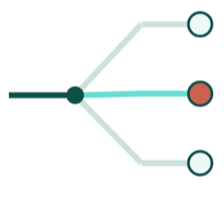
Beyond 2027 · Longer-term bet
4. Prioritization learns which action changes payment
We see potential for causal ML to estimate which intervention helps: requesting a document, making a call, offering approved terms or waiting. A high risk of late payment alone cannot tell a team which action will improve it.
What changes: Attention and concessions can be allocated by expected incremental cash benefit after costs.
What must work: This AR application of uplift modeling 8 needs controlled tests and enough comparable cases.
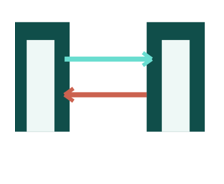
Beyond 2027 · Longer-term bet
5. AR and AP agents coordinate across companies
We see a path for a seller’s AR agent and a buyer’s accounts payable agent to exchange missing documents, invoice acceptance and payment status. Shared task protocols such as A2A 9 provide a technical foundation.
What changes: Routine questions could be resolved directly between systems, reducing uncertainty on both sides.
What must work: Adoption requires shared invoice meanings, trusted identity and explicit authority. Messaging does not authorize payment.
Illustrative case / A professional-services invoice
One invoice. A connected response.
A buyer says an invoice is missing a purchase-order reference.
- 1. Surface request. The language model surfaces the request and its source.
- 2. Verify and correct. The agent verifies the reference, prepares or sends the permitted correction, and checks acceptance.
- 3. Update timing. The prediction model updates expected payment timing.
- 4. Prevent repeats. A confirmed recurring requirement becomes a check on future invoices.
Payment is only recorded after receipt and reconciliation. A disputed fee goes to a person with authority to resolve it.

Autonomy should be earned, action by action
Give agents wider permissions as verified performance improves. Consider the action, amount and customer context. Keep people accountable for disputes, discounts, write-offs and payment terms; retain evidence of what each agent did and why.
For small teams, usable history and connected records are practical limits. Start with rules and review where evidence is thin. Improve models through curated outcomes and revalidation.

Cash outcomes, prediction quality and trust
- Days to collect
- Cash collected
- Team hours
- Time to resolve blockers
- Time to match cash
- Forecast accuracy
- Repeat disputes
- Customer experience
Evaluate intervention impact against a credible comparison group, after concessions and operating costs. Faster activity alone does not establish better cash outcomes.
Sources and scope
- QuickBooks · 2026 Late Payments Report
As reported by QuickBooks. Full survey comparability is unconfirmed.
- QuickBooks · Small Business Insights, July 2026 survey
Monthly, weekly or daily use, including free tools and built-in features. General AI use, not AR-agent adoption.
- QuickBooks · Business Ownership in 2026, December 2025 survey
December 2025 survey: 1,305 US owners, 0–250 employees. Survey populations and periods differ and include businesses outside B2B.
- Federal Reserve · About the FedNow Service
Access and availability depend on the institution.
- Microsoft · Customer payment predictions
- Microsoft · Collections coordinator summary
- Anthropic · Building effective agents (2024)
- Moraes et al. · Uplift Modeling: From Causal Inference to Personalization (2023)
- A2A Project · Agent2Agent protocol specification, v1.0.0
Sources checked Oct 8, 2026. Publisher findings are verified as reported, not independently audited.
Sources 1–3 report small-business survey findings. These samples do not measure Pellucid’s target B2B segment.
5–7 Documented capabilities and agent architecture inform our analysis. 8 General causal-ML methods; the AR use case is our proposal. 9 A general agent protocol, not evidence of widespread AR/AP deployment.