A Pellucid guide
Why AI in Accounts Receivable Needs a Context Layer
Connecting records, conversations and decisions so people and agents can act with the right evidence.
An AI agent can draft a collection email or suggest which invoices a payment covers. To carry out that work reliably, it also needs to understand the circumstances around the account: what the customer has said, which agreements apply, what someone has already approved and what remains unresolved.
Consider an illustrative $400 short payment. The accounting system shows an open balance, but the customer says freight was included in the agreed price. The account manager remembers an earlier adjustment. An agent using only the balance and a reminder schedule could send another notice before anyone checks whether the deduction is valid.
An experienced AR specialist would investigate the agreement, the earlier decision and its scope. Making that knowledge available to agents requires more than an open-invoice feed.
Theory Ventures illustrates the gap by imagining Einstein starting a back-office job: even he would need to learn how the company operates before he could be useful. It describes the need for a business context layer: company-specific operating knowledge that is maintained over time and supplied to AI systems when they do the work.
Our view is that a context layer is how that knowledge becomes available to agents and stays current. In accounts receivable, its value comes from connecting evidence to the decisions and actions needed to move an invoice toward resolution.
What a context layer is
A context layer connects the information needed to understand and act on a business situation. It brings together source records, applicable policies and the history of relevant decisions, while preserving where that information came from and who is permitted to use it.
It can be part of an AR platform or a shared capability across systems. The accounting system continues to hold the official posted balances. The context layer helps explain the circumstances around those balances and supports the next step.
Three kinds of information matter.
How the company works. This includes policies, approval limits, customer agreements and operating practices. Written policy and informal practice need different treatment: an established habit may be useful context, but someone with the right authority must determine whether it is permitted.
What happened. An invoice was issued, a customer questioned a charge, a payment arrived or a credit was posted. These events may be recorded in one system or spread across several. Linking them helps a person or agent reconstruct the case.
Why a decision was made. What evidence supported an adjustment? Which policy applied? Who approved an exception, and what did that approval cover? Foundation Capital uses the term decision traces for these case-specific records and argues that capturing them during a workflow can preserve the basis for future decisions, including when a person makes the final call.
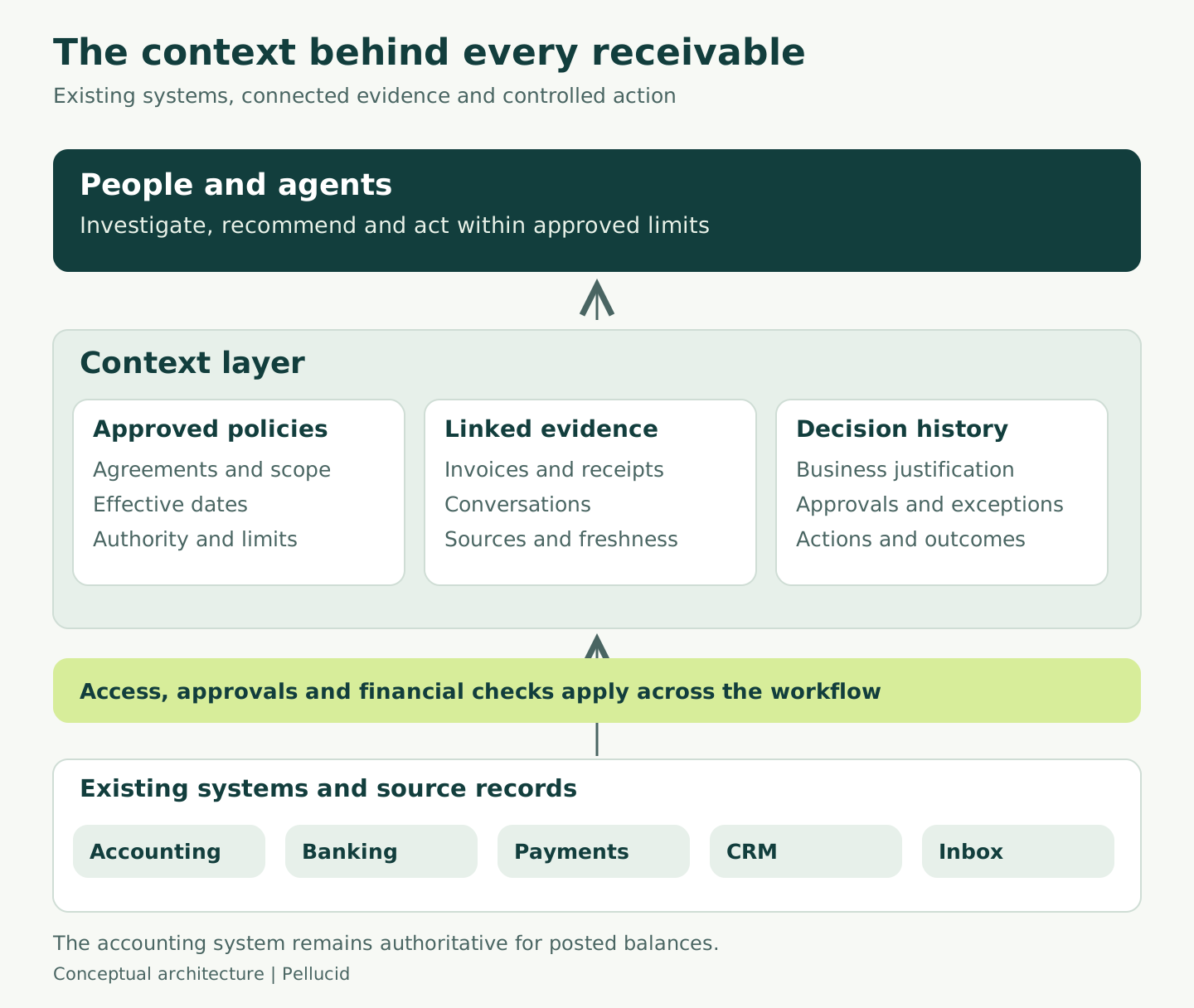
A context graph is one way to represent the relationships among records, people, policies and decisions. The context layer describes the capability the business needs; a graph describes a way to organize part of that information. A first implementation can use linked records and a structured decision log without requiring a specialized graph database.
What an open balance does not explain
Accounting systems can hold attachments, communications, approvals and transaction history. The problem arises when the relevant information was never captured, was attached to a different record or is difficult to retrieve when a decision needs to be made.
An open balance is therefore the beginning of an investigation. Its cause and appropriate treatment depend on the supporting evidence.
| Recorded transaction or status | Additional context needed | Possible source |
|---|---|---|
| A $400 credit memo | Why it was issued, who approved it and whether the approval was limited to one invoice | Credit documentation, agreement or approval record |
| An invoice open for 60 days | Whether the customer accepted it and whose sign-off is outstanding | AP portal, customer email or project approval |
| An unapplied receipt | Which invoices it settles and whether a deduction is included | Bank reference, remittance or customer communication |
| Follow-up placed on hold | The reason, responsible owner and review date | Collection record, dispute case or internal note |
| A promise to pay | The amount, expected date and what happens if the promise is missed | Customer message or confirmed call note |
| A written-off balance | The investigation, supporting policy and authorized decision | Accounting record and approval evidence |
These sources can disagree. A customer may say an invoice was paid while the bank record is incomplete, or an account note may refer to terms that have since changed. A useful context layer makes the disagreement visible and identifies what needs checking.
The accounting system remains authoritative for posted balances. Bank and payment records provide evidence of receipts and settlement. Differences need investigation and reconciliation; an agent should not assume that either an open balance or a customer assertion settles the question.
Our guide to unpaid B2B invoices explores the situations to investigate before choosing a collection action.
Why accounts receivable is a useful place to start
Receivables connect billing, sales, customer success, treasury and the customer’s AP team. Resolving a case may require information from several of them, even when each individual system is working as intended.
A short payment, for example, can reflect a billing error, a commercial disagreement, a permitted deduction or an incomplete remittance. The same amount can require different actions depending on the evidence. Connecting the records helps the team determine which situation it is handling and who can resolve it.
Context also accumulates at the account. Agreements, payer relationships, recurring billing problems and prior resolutions can affect later invoices. Actively’s Anshul Gupta makes a related argument about account-level context in sales: history can be reconstructed from existing communications, but recording decisions during execution preserves information that might otherwise be lost. Applying that idea to receivables means retaining account history while checking the scope of each agreement and decision.
Financial accuracy adds another requirement. Amounts, allocations and accounting entries need validation against source records. A history of approved decisions can help explain an action, but it does not remove the need for reconciliation, authorization or current evidence.
The opportunity is practical: less time searching for information, clearer responsibility and fewer repeated investigations. Whether a particular implementation delivers those benefits needs to be measured.
What an agent should establish before acting
A useful AR agent should be able to work through six questions:
- What is the current state of this receivable?
- What is preventing payment or accurate reconciliation, and what evidence supports that explanation?
- What is still unknown, stale or contradictory?
- What action is appropriate now, and who owns it?
- Is the action permitted, does it require approval or should the case be escalated?
- What happened after the action, and what should be reviewed for improvement?
An agent needs to distinguish a customer’s claim from a verified fact or an authorized decision. A customer’s statement is a claim to investigate. A bank record is evidence of a receipt, subject to settlement and identification checks. An employee’s interpretation is a proposed explanation. An approved exception records a decision within a defined scope. A current policy establishes the applicable rule and authority.
These distinctions matter when information is summarized. “The customer says freight was included” should not silently become “freight was included.” Likewise, an earlier approval should not become standing permission for future credits.
When the evidence is incomplete, the agent should show the gap and route a specific question to the right person. That is a useful result: it moves the investigation forward without presenting an unsupported conclusion as settled fact.
How to build useful context
Match the right records
Start with customers, payers, legal entities, invoices and payments. Similar names alone are insufficient to establish that two records belong together. Use corroborating identifiers and review uncertain relationships before relying on them.
Define which system is authoritative for each important field. Keep customer and payer relationships explicit so a payment from a parent company can be investigated without merging separate legal entities or exposing records to the wrong people.
Preserve decisions as the work happens
For each material decision, retain the relevant source records, business justification, policy version, approver, scope, action and result. Record what was available at the time and any later correction, rather than replacing the history with the newest interpretation.
A generated explanation is only useful if the evidence supports it. Preserve the operational justification and approval record so another person can understand and check the action.
Keep context current
Agreements can expire, policies can change and a one-time exception can be superseded. Store effective dates and scope, identify who maintains the information and surface conflicts for review.
A freight concession might cover one customer entity, certain products or a limited period. Those conditions belong with the decision so a later case can be checked against them.
Make policies readable and enforceable
Finance should be able to inspect policies and propose changes in language it understands. Updates still need an authorized owner, testing and a controlled release.
Theory Ventures highlights the value of human-readable business rules that domain experts can maintain. In finance, those rules also need enforcement through permissions, approval checks and validated software operations. An instruction in a prompt does not, by itself, prevent an unauthorized posting.
Our guide to building AI agents for finance teams covers how to define authority, validate actions and maintain an audit trail.
Preserve permissions and company boundaries
Connecting records should preserve the access restrictions that apply to them. A person or agent should only receive the information permitted for the task, including restrictions by role, customer and legal entity.
A common AR vocabulary can be reused across businesses. Each company’s private records, policies and decisions need their own controls. Cross-customer learning requires a separate decision about permitted data use; it should not be assumed as a consequence of building a context layer.
Turn feedback into tested improvements
Record what the agent proposed, what a person corrected, what was executed and what happened afterward. Then determine whether the correction concerns a fact, a customer relationship, a policy or the decision process.
Those distinctions lead to different changes. Correcting a payer association may improve future matching. Changing an approval rule requires policy authority. Improving a model or prompt requires evaluation against representative cases.
Captured history provides material for learning. Improvement follows from reviewing that material, testing a proposed change and checking its effect after release. A payment arriving after a reminder does not establish that the reminder caused it.
The $400 deduction, revisited
The following example is illustrative and does not describe a real customer.
In the first quarter, a distribution customer pays an invoice $400 short and says freight was included in its agreement. The account manager finds the applicable contract clause and sends it to the designated credit approver. The approver authorizes an adjustment for that invoice, and AR posts the credit.
In this example, the approval remains in an email thread without being linked to the accounting transaction. The credit is recorded, but someone investigating a later deduction must search separately for its basis.
In the second quarter, the customer deducts another $400 freight charge. A newer specialist sees the open balance and sends a reminder. The customer replies, frustrated, pointing to the earlier agreement. The account manager spends half a morning finding the old approval and helping AR reconstruct the case. The team still needs to establish whether the current invoice is covered by the agreement.
With the context linked, an agent can retrieve the earlier decision and its supporting documents. It checks the customer entity, the current invoice, the applicable contract version and the agreement’s effective period. It also checks whether the earlier approval was invoice-specific and which role can approve a new adjustment.
If the evidence supports the new deduction, the agent prepares a $400 credit proposal for the authorized approver. If the scope is unclear or the agreement has changed, it asks for clarification. If reminders are paused, the team should record the reason, assign an owner and set a date to review the case, following its collection policy.
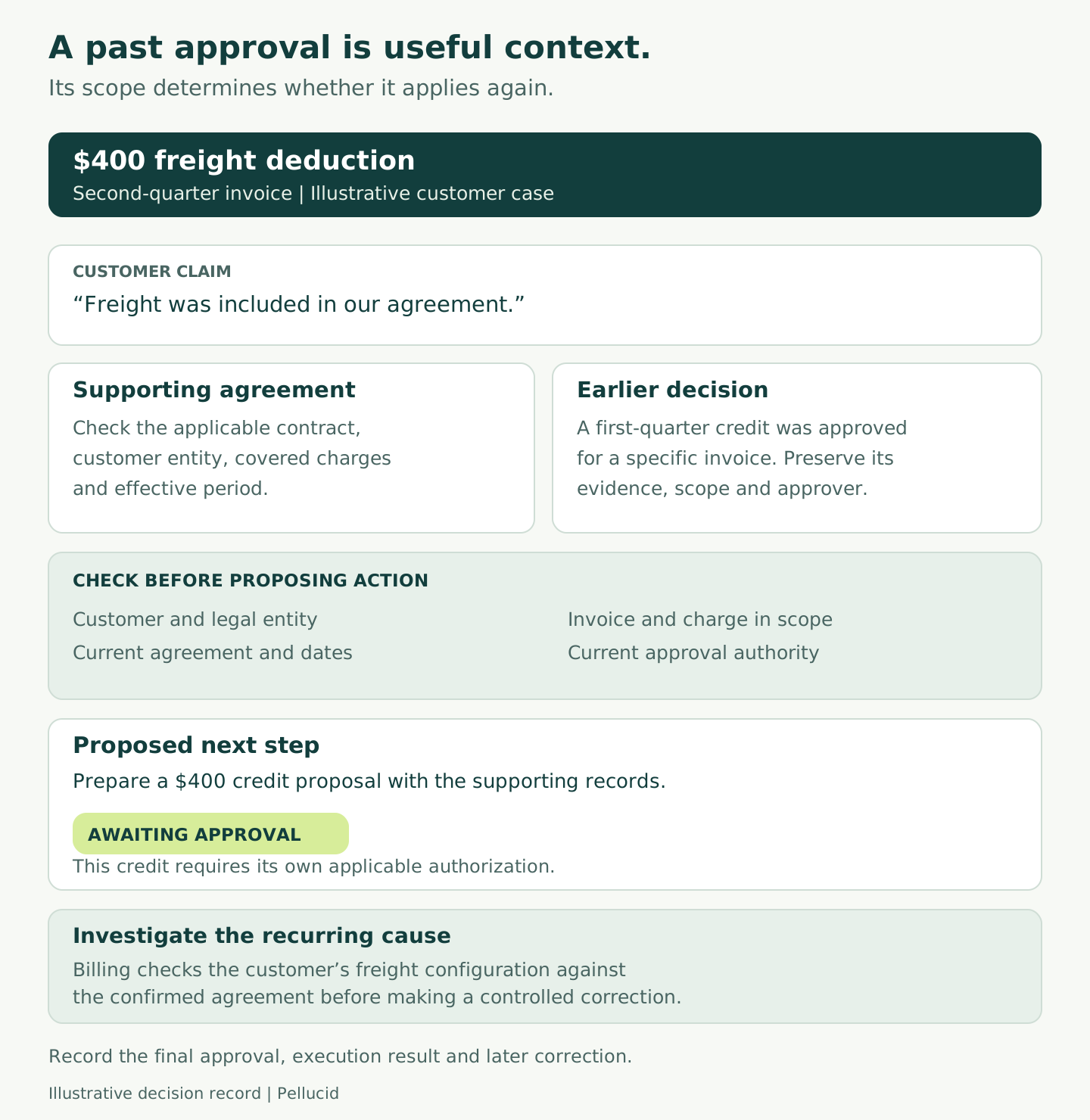
The case can also reveal a recurring cause. Billing checks whether the customer’s freight configuration conflicts with the confirmed agreement. After the appropriate review, the team corrects that configuration and verifies the next invoice.
The benefit is a shorter path from a disputed balance to an informed decision, with enough history to explain both the adjustment and the underlying correction.
Start with one recurring exception
A context layer does not need to begin as a company-wide infrastructure project. Choose a recurring exception whose investigation can be reconstructed, such as freight deductions, missing POs or payments from parent companies.
Review a small set of recent cases. For each, record the source documents, relevant agreement, responsible owner, approval, action and result. Note where information was missing, how long the investigation took and whether the underlying problem returned.
Then test whether another team member can resolve similar cases using those linked records with less searching and equal or better accuracy. Measure investigation and resolution time, correct owner assignment, incorrect reminders or adjustments, review effort and recurrence.
Historical records will have gaps. Use them to establish an initial picture, then capture decisions during ongoing work. Expand the approach when the results justify the additional connections and upkeep.
For teams comparing products, our AR software buyer’s guide includes questions about integration depth, evidence, controls and how to evaluate performance on your own cases.
Where Pellucid fits
Pellucid is an AI-Native accounts receivable platform for B2B finance teams.
We’re building Pellucid around a context layer for receivables, working alongside existing accounting systems. Our direction is to connect the records, conversations and decisions behind an invoice so teams can understand what is holding up payment, identify the next action and its owner, and enable agents to complete permitted work within agreed controls.
People remain involved where judgment, approvals and customer relationships matter. The goal is to help businesses get paid sooner, collect more of the cash they are owed and give finance teams time back.
Where does context get lost in your receivables? Talk to us about how your team investigates and resolves those cases.
Sources and further reading
- Theory Ventures: “Why the Business Context Layer Is the Key to Making AI Work in Enterprise”.
- Foundation Capital: “AI’s trillion-dollar opportunity: Context graphs”, December 22, 2025.
- Actively: “Building Context Graphs for GTM, and Why Salesforce Can’t Do It”, January 2, 2026.
The AR application, illustrative case and suggested starting exercise are Pellucid’s perspective. The linked essays provide investment and commercial viewpoints on context layers and decision history.